

B2B Distribution Operations Management Software
Control Orders, Dispatch, Delivery, Fleet, Inventory & Compliance Workflows
B2B distribution operations software for managing customer orders, dispatch, proof of delivery, claims, fleet compliance, inventory controls, invoicing, and audit workflows across warehouses, routes, and teams.
Quick Overview
B2B distribution operations software.
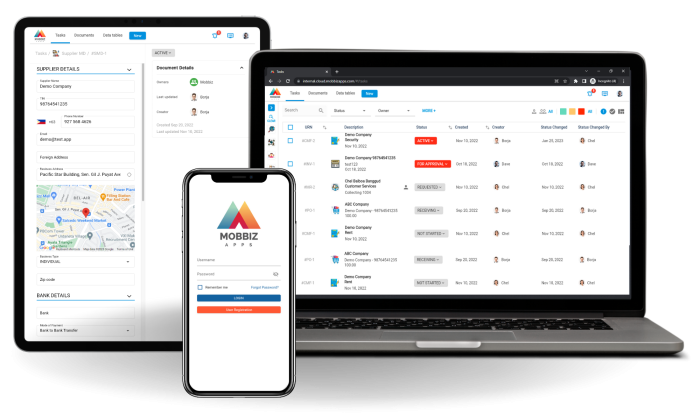
B2B distribution operations software standardizes how work is executed across order handling, dispatch, delivery, proof of delivery, claims, fleet, inventory, and compliance workflows. Mobbiz acts as an operational governance layer, helping ensure:
Structured workflows and approvals
Evidence capture such as POD, documents, and photos
Real-time operational visibility
End-to-end traceability across orders, deliveries, and claims
Audit-ready execution across teams, warehouses, and logistics partners
B2b Video Platform
What Mobbiz delivers
See how Mobbiz helps B2B distribution teams manage operational workflows across orders, dispatch, delivery tracking, proof of delivery, fleet coordination, customer claims, inventory controls, and compliance activities.
Key Takeaways
#1
B2B distribution operations require structured execution beyond ERP, WMS, or TMS
#2
Operational governance ensures workflows are executed with approvals, evidence, and audit trails
#3
Mobbiz standardizes order-to-delivery workflows across teams, warehouses, and logistics partners
#4
Proof of delivery, claims, fleet compliance, and inventory controls become fully traceable
#5
AI delivers the most value when embedded within governed workflows
Common Questions
About B2B Distribution Operations Software
#1
What is B2B distribution operations software?
Software that standardizes and governs how operational work is executed across orders, deliveries, claims, fleet, and inventory workflows.
#2
What is proof of delivery (POD)?
A structured record confirming delivery completion, including signatures, photos, timestamps, and supporting documents.
#3
What does operational governance mean in distribution?
It means enforcing workflows, approvals, evidence capture, and audit trails across operational activities.
Definition
What Is B2B Distribution Operations Software?
B2B distribution operations software is designed to standardize and control how operational work is executed, not just recorded
It governs workflows across:
- Customer orders and dispatch
- Delivery execution and proof of delivery
- Incident and claims handling
- Fleet and compliance activities
- Inventory control and adjustments
- Billing support and operational traceability
This improves:
- Consistency across teams and locations
- Accountability across workflows
- Visibility into operational execution
- Traceability from order to outcome
The Gap
Why B2B Distributors Need a Governance Layer
Common systems used by distributors
Where gaps occur:
A governance layer connects and standardizes execution across these gaps.
Stack Fit
How Mobbiz Fits Into Your Existing Stack
Mobbiz sits between execution and systems of record.
It structures workflows across:
This creates a more controlled operating model across departments and partners.
Governance Platform
What Is an Operational Governance Platform for Distribution?
An operational governance platform orchestrates how work gets done across people, systems, and partners..
Unlike ERP or WMS, it enforces:
It governs execution, not just transactions.
B2B Distribution Software vs ERP vs WMS vs TMS
| System | Primary Role | Strength | Limitation |
|---|---|---|---|
| ERP | Transaction recording | Finance, invoicing, stock | Limited operational workflow control |
| WMS | Warehouse execution | Picking, storage, movement | Not end-to-end distribution |
| TMS | Transport planning | Routing, freight coordination | Limited claims and compliance workflows |
| BPM | Process automation | Flexible workflows | Too generic for operations |
| Task Tools | Task tracking | Simple coordination | Weak auditability |
| Operational Governance Platform | Execution control | Approvals, evidence, traceability | Requires structured process design |
Common Operational Challenges in Distribution
Operational Areas Covered
| Area | Processes | Business Impact |
|---|---|---|
| Order Management | Orders, line items | Accuracy and fulfillment control |
| Dispatch & Routing | Routes, suppliers, quotes | Cost control and efficiency |
| Delivery Execution | Tracking, POD, feedback | Service quality and visibility |
| Claims & Incidents | Damage, shortages | Faster resolution and traceability |
| Fleet Operations | Drivers, compliance | Risk reduction |
| Maintenance | Preventive and repairs | Reliability |
| Inventory Control | Transfers, counts, adjustments | Stock accuracy |
| Billing Support | Invoices, payments | Financial traceability |
| Compliance & Audit | Checks, actions | Governance and risk control |
| Reporting | Sales, operations | Performance visibility |
Key Capabilities
Workflow configuration aligned to operations
Approval governance across key steps
Proof-of-delivery capture with photos, signatures, and documents
Route coordination and delivery tracking
Incident and exception management
Claims traceability linked to orders
Fleet compliance and driver validation
Preventive maintenance tracking
Inventory workflow control and approvals
Audit trails and corrective action tracking
Real-time dashboards and reporting
Order → Dispatch → Delivery → Proof of Delivery
Structured execution from order creation through final handover with full traceability.
Delivery Incident → Customer Claim
Incidents are captured in real time and linked directly to claims and orders.
Freight Quote → Approval → Dispatch
Supplier pricing is compared, documented, and approved before execution.
Vehicle Compliance → Route Assignment
Only compliant vehicles and drivers are assigned to deliveries.
Inventory Variance → Adjustment → Audit
Stock discrepancies trigger structured review and corrective action.
Growth
Why This Matters for Growing Distribution Businesses
As distribution grows, complexity increases
Every dimension of your operation expands — and so does the burden of managing it manually.
More orders
More routes
More suppliers
More exceptions
Without structured workflows, execution breaks down
Operational gaps widen as teams struggle to maintain control without a governance structure.
Increasing risks
Weak accountability
A governance layer enables scalable, audit-ready operations
Structure your execution so your business grows without losing control, visibility, or accountability.
Clear ownership
Audit-ready
Consistent delivery
AI-Ready Distribution Operations
AI delivers value when applied to structured workflows, including:
Document Data Extraction
From delivery notes and PODIncident Classification
Identify and categorize operational eventsWorkflow Routing
Prioritization and structured executionReporting Automation
Generate insights and visibilityWhen should you consider a governance layer?
If any of these apply to your operations, it's time to act.
Spreadsheet-Driven Operations
Operational workflows managed across spreadsheets or email with no structured control.Inconsistent Field Evidence
Proof of delivery and field evidence are inconsistent, incomplete, or hard to retrieve.Untraceable Claims
Claims and incidents are difficult to trace back to their operational source.Disconnected Controls
Fleet, compliance, and inventory controls operate in silos with no unified visibility.Manual Audit Preparation
Audit preparation is entirely manual, time-consuming, and prone to gaps.Scaling Is Increasing Risk
Growing operations are adding complexity and risk faster than your controls can keep up.Related Terms in Distribution Operations
Related Concepts and Systems
This page references commonly used systems such as:
Mobbiz complements these systems by governing how operational work is executed across them.
Frequently Asked Questions
Is B2B distribution operations software the same as ERP software?
No. ERP records transactions. This software governs how operational work is executed around those transactions.
Is this the same as WMS or TMS software?
No. WMS focuses on warehouse execution and TMS on transport. Governance platforms connect broader workflows across operations.
Can this work with existing systems?
Yes. It complements ERP, WMS, accounting, and reporting systems.
What workflows can be standardized?
Order handling, dispatch, delivery tracking, POD, incidents, claims, fleet compliance, inventory controls, and corrective actions.
How does this help with customer claims?
Claims are linked to orders, deliveries, incidents, and supporting evidence.
Can third-party logistics providers be included?
Yes. Supplier coordination and execution can be governed within workflows.
Where does AI fit?
AI supports document-heavy and exception-heavy workflows within structured governance.
Talk to Mobbiz About Your Distribution Operations
Mobbiz provides an operational governance layer for B2B distribution companies that need structured workflows, approvals, evidence capture, and audit trails across teams, warehouses, drivers, and logistics partners.
Email: info@mobbizsolutions.com

- 8th floor, 105 Rada street Makati, 1223 Philippines
- 160 Robinson Road, #14-04 Singaporean Business Federation Centre, Singapore 068914
- +63 917 709 63 74
- +34 686 04 46 20
- info@MobbizSolutions.com