

The Gray Zone of Operations: Where Your ERP Stops
and Email, Excel and WhatsApp Begin
It is Friday, 6 p.m. A supplier needs an approval before Monday. The request sits in an email thread, the budget check lives in a spreadsheet, and the only person who knows the exception rule is on vacation. By Monday, someone will approve it from memory, and nobody will remember who did, or why.
Borja Hernández Celorio, CEO · Published 25 November 2026
Request
Initiation
Approval
Authorization
Review
Validation
ERP Record
System of record
Your ERP will faithfully record the purchase order later. It will record none of the above. That missing middle is what we call the gray zone.
In short
The gray zone of operations is the stretch of work between the start of an operation and its entry into a system of record. It includes every request, approval, review and validation that has to happen before a transaction can be booked. ERPs, accounting systems and in-house applications do their job once the data arrives. The gray zone is what happens on the way.
Operational governance brings that work under defined data, flow, roles and business rules, so the method is followed every time.
It does not replace your ERP: it integrates with your existing systems or manages configured operational records directly.
A first process can typically reach production in a few weeks, and later changes are applied in minutes through configuration.
The gray zone of operations is everything that happens between the moment an operation starts and the moment it is recorded in a system of record: requests, approvals, reviews and validations. Your ERP stores the result. The gray zone is where the work is actually done, and when several teams, sites or external companies take part, it usually runs on email, spreadsheets, paper and chat.
What Is the Gray Zone of Operations?
The gray zone of operations is the stretch of work between the start of an operation and its entry into a system of record. It includes every request, approval, review and validation that has to happen before a transaction can be booked. ERPs, accounting systems and in-house applications do their job once the data arrives. The gray zone is what happens on the way.
| System of record (ERP, accounting, in-house systems) | The gray zone | |
|---|---|---|
| What it holds | What happened: the finished, booked transaction | How it happens: requests, approvals, reviews and validations |
| Who works in it | Finance, accounting and trained system users | Several teams and sites, plus suppliers, distributors, field staff and contractors |
| Typical tools | The ERP and other systems of record | Email, spreadsheets, paper, chat, Teams and verbal approvals |
| Evidence | The final record | Scattered across inboxes, photos and papers |
“ERPs keep the score. The gray zone is where the game is played.”
Why Doesn’t Your ERP Cover the Gray Zone?
Because it was not built to. An ERP is a system of record: it makes sure that what gets booked is consistent and complete. It is not designed to guide a supplier through a form, remind a branch manager about a deadline, or let a contractor upload evidence from a site with no signal. Extending it to do all that usually means customization, extra licenses and training, so many organizations leave that work outside the system. The record ends up precise, and the method ends up improvised.
Seven Signs You Are Running Part of Your Business in the Gray Zone
How do you know if you have one? Count how many of these sound familiar:
Approvals live in email threads, chats or verbal agreements.
Only a few people know how the process really works, and it stalls when they are away.
Each team or site applies the method its own way.
Every audit means reconstructing who approved what, and when, from inboxes, photos and papers.
Suppliers, distributors or field teams send data by email or photo, and someone retypes it.
The same data is entered twice: once in a spreadsheet and again in the ERP.
Changing a step in the process needs an IT project or a custom development, so it rarely changes.
If three or more ring true, a meaningful part of your operation is probably running in the gray zone.
What Does the Gray Zone Cost?
Nothing about it appears as a line in the budget. It appears as delays, errors, rework and audit stress, in four forms:
The method lives nowhere.
Each team applies it differently, the know-how sits with a few people and omissions are detected late.
There is no evidence.
Who approved what, and when, is spread across emails, photos and papers, so every audit starts with a reconstruction.
External parties stay outside.
Suppliers, distributors and field teams work outside your systems, so their data is re-entered by hand.
Change takes months.
Adapting a process depends on IT projects or custom development.
How Do You Govern the Gray Zone? Four Building Blocks
Operational governance means turning your way of working into a system that is predictable, repeatable and scalable, from the origin of each operation to its entry in the system of record. Any process, in any industry, can be described with four building blocks:
| Building block | The question it answers | Example (purchase approval) |
|---|---|---|
| Data | What is captured? | Supplier, amount, cost center, quotes attached |
| Flow | What happens, and in what order? | Request → budget check → approval → purchase order |
| Roles | Who does what? | Requester, budget owner, procurement, finance |
| Business rules | What is allowed? | Amounts above a threshold need a second approver |
When the four pieces live in one platform, the method guides each step, the system controls deadlines and escalations, and every action is recorded with its evidence.
What Changes When the Gray Zone Is Governed?
The method is followed.
The system guides each step, sends reminders and escalates by email or SMS. If someone is absent, the process keeps going.
Everything is recorded.
Who did what and when, with photos and documents as evidence. Always ready to audit.
Everyone works in one system.
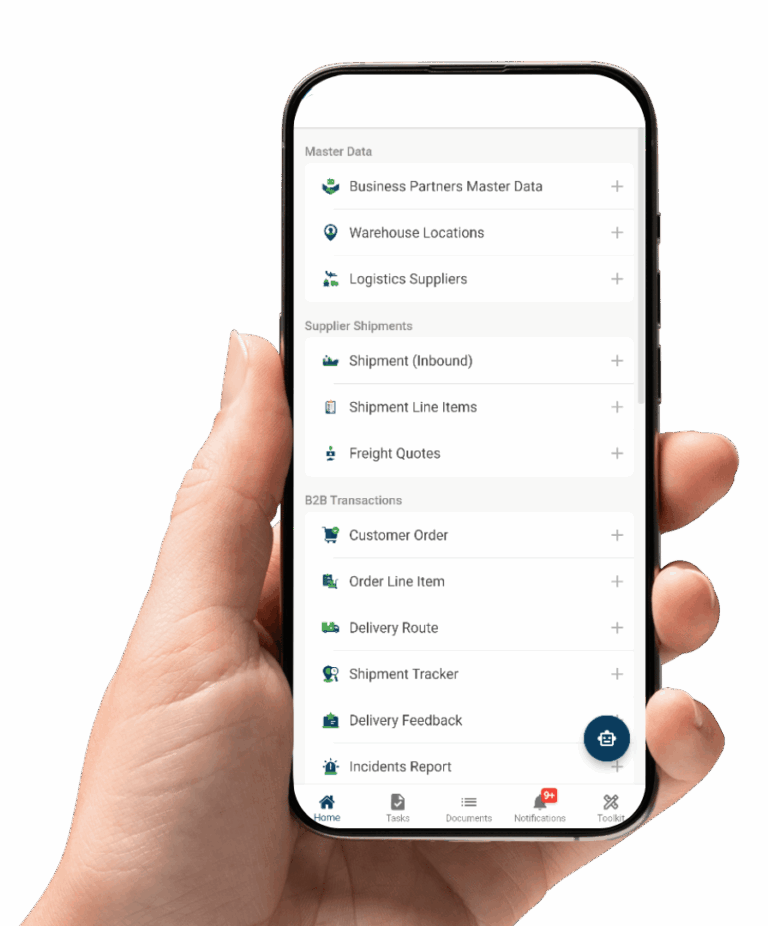
Office, branches, field teams, suppliers and contractors, through web portals and mobile apps that work offline.
Data is captured once.
Captured at the source, it reaches your ERP, accounting or asset system clean and in real time, without double entry.
Routine work is automated.
Validations, reconciliations, invoices, certificates and emails.
Does Governing the Gray Zone Mean Replacing Your ERP?
No. Governing the gray zone is about how work reaches the system of record, not about replacing it. An operational governance platform such as Mobbiz integrates with existing ERP, CRM, accounting and other systems, or manages configured operational data directly where no suitable system exists.
Task and project boards are flexible but do not enforce a method; ERPs guarantee consistency but are slow and costly to adapt. A governance platform aims for both at once.
What Does It Look Like in Practice?
An engineering consultancy
that has carried out more than 3,000 building and bridge surveys moved field data capture to offline mobile forms, with a six-level review and digital signatures. It reports about 85% fewer data-entry errors and approvals about 80% faster.
A microfinance lender
with more than 300 branches captures loan applications in an offline mobile app that posts into its own loan-origination system. It reports 60–80% faster turnaround and records that are 100% audit-ready.
A beverage distributor
replaced Excel in its sales assessments and field visits with a hierarchy of up to seven levels and deadline reminders. It reports about 90% fewer errors, about 90% less consolidation effort and same-day results.
These results are reported by the clients, depend on their starting conditions and are not guaranteed. As a planning reference, implementations typically target operational savings of around 20–40% within the first six months of use (how to calculate the return on workflow automation); this is not a guaranteed outcome.
Where Does AI Fit In?
AI agents can take on repetitive work in the gray zone: extracting data from documents, checking a document against a policy, drafting emails. The risk is that a model can produce any result, and in an operation that is a problem. The safe way is to let agents work inside the same four building blocks as people (data, flow, roles and business rules), with human validation where required and every action recorded. AI is optional: each company decides in which steps to use it. To go deeper, read how to deploy AI agents in operations without losing control.
How Do You Start?
Start with the process that most affects your results, not the biggest one. The path has four stages:
Diagnosis (days)
Start from what the company already uses (Excel, forms, documents) to understand who takes part and what fails.
Model (days)
Draw the map of the solution and define the data, flow, roles and rules of each process.
Production (typically 2–4 weeks with pre-configured modules, 4–8 with tailored processes)
Configuration, integration and training, validated with the company in short cycles.
Continuous improvement
Each change is applied in minutes, and the next processes build on the same base.
What the company brings: a process owner, access to the key users and information about the systems to integrate. See the pre-configured modules and the pricing to understand the scope of each starting point.
Frequently asked questions
What is the gray zone of operations?
It is everything that happens between the moment an operation starts and the moment it is recorded in a system of record: requests, approvals, reviews and validations. When several teams, sites or external companies take part, it is usually managed with email, spreadsheets, paper and chat.
What is operational governance?
It is the practice of defining and enforcing how work is done: which data each person captures, in what order, with which permissions and under which business rules, with every action recorded. In Mobbiz it is delivered as a configurable no-code platform that guides each step from the origin of the operation to its entry in the system of record.
Does governing the gray zone mean replacing my ERP?
No. Mobbiz integrates with existing ERP, CRM and accounting systems, or manages configured operational data directly where no suitable system exists. It is not intended to replace your system of record.
Why not manage approvals with email, Excel and chat?
They work for a few people and a low volume. As soon as several teams, sites or external companies take part, they cannot enforce the method, keep reliable evidence, give external users controlled access or scale without more manual follow-up.
Which processes should I govern first?
Those that most affect your results, usually the ones with many participants and external parties, such as purchase approvals, supplier onboarding, field audits and inspections, customer onboarding or invoicing.
How long does it take to put a first process under control?
A first process can typically reach production in 2–4 weeks with a pre-configured module, or 4–8 weeks for a tailored process, depending on scope. Once it is live, changes are applied in minutes through configuration.
Can suppliers, distributors and field teams take part without access to our systems?
Yes. External users work through branded web portals, public forms that do not require creating a user, and mobile apps that work offline. Access is controlled by role, down to each field, and they never need an account in your ERP.
Do I need AI to govern the gray zone?
No. AI is optional. When it is used, agents follow the same data, flow, roles and rules as people, with human validation where required and every action audited.
Is this only for large corporations?
No. It is designed for corporations and mid-sized companies in which many people, internal and external, run the same processes.
See Your Own Gray Zone in a Demo
Bring one real process to a Mobbiz demonstration. We will map who takes part, which approvals and evidence it needs, and where the gray zone sits.
Email: info@mobbizsolutions.com